 Difio
A short history of spot-the-difference puzzles
Updated:
Everyone has solved one: two drawings that look identical until you start comparing them. But who came up with the idea? The honest answer is that nobody knows for sure. This is what can actually be traced, with the sources at the end.
Nobody knows who invented it
In 2020 a reader asked Japan's National Diet Library, the country's national library, when and by whom the puzzle had been invented. Its reference service searched encyclopedias, reference books on games and children's play, newspaper archives and old children's magazines. The conclusion was blunt: it found no document that directly explains where the puzzle comes from.
What the library did find is a trail of early examples, and that trail is the best map we have. It runs mainly through Japanese and English-language sources, so other countries surely have chapters of their own still waiting to be written.
Its older cousin: «what's wrong with this picture?»
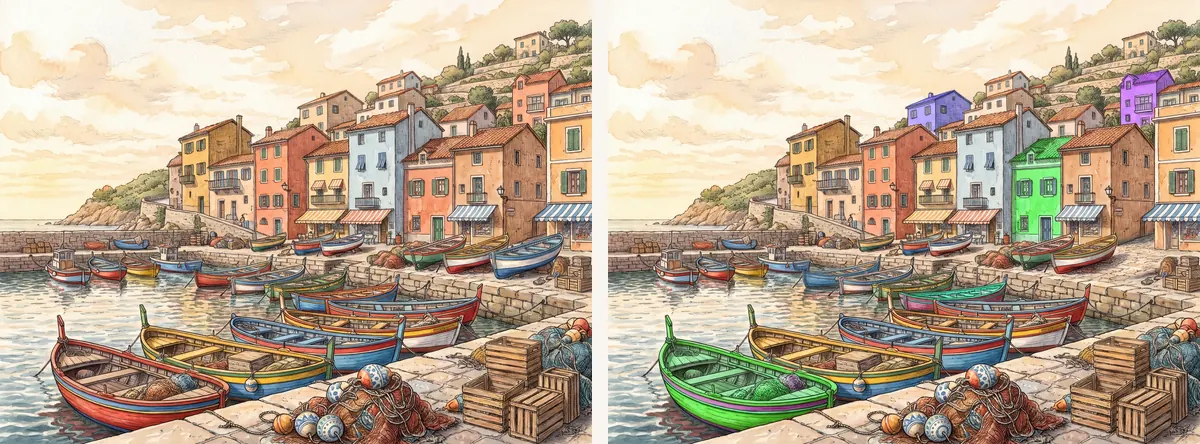
The library separates two kinds of puzzle. In the first there is a single drawing full of things that make no sense, and you have to find the mistakes. In the second, the one Difio is built on, there are two nearly identical pictures and you have to find what changed.
The single-picture kind shows up first. In the archive of the Asahi Shimbun newspaper the library found one from 1931, and in November 1936 the Yomiuri Shimbun ran a prize cartoon under the name machigai sagashi, «looking for mistakes», which is still what the puzzle is called in Japan. A Yomiuri prize cartoon from September 1937 already comes close to the two-picture format.
Two pictures side by side: children's magazines
In the Japanese children's magazines the library searched, the examples from 1949 to the mid-1960s are mostly of the single-picture kind. It points to a few from the 1950s that come close to the two-picture format, and finds clear two-picture puzzles in magazines from the publisher Shogakukan in 1966 and 1967.
Newspapers: Hocus-Focus
In the United States, the newspaper panel «Hocus-Focus», distributed by King Features Syndicate, showed two similar drawings with six differences between them. According to its entry in Wikipedia, it was started around 1965 by Hal Kaufman, and for many years it was drawn by the cartoonist Henry Boltinoff, who worked on it until his death in 2001.
That same panel is how the format reached many Japanese readers. From February 1975 to March 1978, the Yomiuri Shimbun published Boltinoff's drawings every Sunday under the title おや、違ってる («Oh, something's different»). The National Diet Library believes this is when the two-picture puzzle became widely known in Japan.
Books and puzzle magazines
From the mid-1970s the format turns up regularly in books and magazines:
- United States, 1975. Joel Rothman's children's book «Which One Is Different?» was published by Doubleday.
- United Kingdom, 1977–1978. A 1978 press directory describes the magazine «Puzzled», launched in August 1977, as offering «spot-the-difference puzzles». It is one of the earliest uses of that name the library could find.
- Japan, 1983. The puzzle magazine «Pazzler», launched that year, included machigai sagashi among its puzzles.
A restaurant classic
In Japan the puzzle also became a restaurant tradition. Since 2005 the Saizeriya restaurant chain has printed a spot-the-difference with ten differences on its kids' menu (since 2025, on its dessert menu), renewed several times a year. It is famous for being hard: in 2018 the company told the news site J-CAST that it deliberately hides two or three differences that are difficult to find, and that children often find them before adults do. That year a book collected the puzzles, and in June 2025 the chain renewed the drawings with the art director Chie Morimoto.
From paper to screens
Touchscreens suit this puzzle perfectly: instead of circling a difference with a pen, you tap it. In bars and restaurants in the United States, Megatouch touchscreen machines included «Photo Hunt», with two photos that differed in five places, a timer and hints. It was later released for the iPhone.
Today spot-the-difference is a whole genre in the app stores, and digital versions add things paper can't: zooming in on a detail, hints that point you to the right area, and new pictures that keep arriving.
One puzzle, many names
The game goes by different names around the world. In Japanese it is machigai sagashi («looking for mistakes»), in French jeu des erreurs («game of mistakes»), in Dutch zoek de verschillen («look for the differences»), in Chinese 找不同 («find what's different») and in Korean 다른 그림 찾기 («find the different picture»).
The number of differences isn't fixed either: Hocus-Focus used six, Photo Hunt five and Saizeriya's menu ten. In Spanish the game is often called las siete diferencias, and Difio keeps that classic number: every level has exactly seven.
Sources
- National Diet Library, Collaborative Reference Database: 2枚の絵を見比べて間違いを探す「間違い探し」は、いつ・誰が考案したのか (in Japanese, 2020, updated 2021). Japanese newspapers and magazines, the Yomiuri serial, Hocus-Focus, Rothman, «Puzzled» and «Pazzler».
- Wikipedia: Henry Boltinoff. Hocus-Focus, its start and its format.
- Wikipedia: Photo Hunt. The Megatouch game and its iPhone version.
- J-CAST News: サイゼ広報もギブアップ!「ムズすぎ」間違い探しが本に (in Japanese, 14 July 2018).
- J-CAST News: サイゼリヤ、名物「間違い探し」デザイン刷新を発表 (in Japanese, 25 June 2025).