 Difio
The five types of differences
Updated:
Every difference in Difio belongs to one of five types. Knowing them changes the way you look at a picture: instead of searching for «something different», you go looking for something specific. The examples are real differences from published levels, and the percentages come from all 378 differences in the 54 levels published as of November 2026.
| Type | Differences | Share |
|---|---|---|
| Colour change | 116 | 31 % |
| Replaced object | 89 | 24 % |
| Missing object | 85 | 22 % |
| Size change | 58 | 15 % |
| Flipped object | 30 | 8 % |
1. Colour change
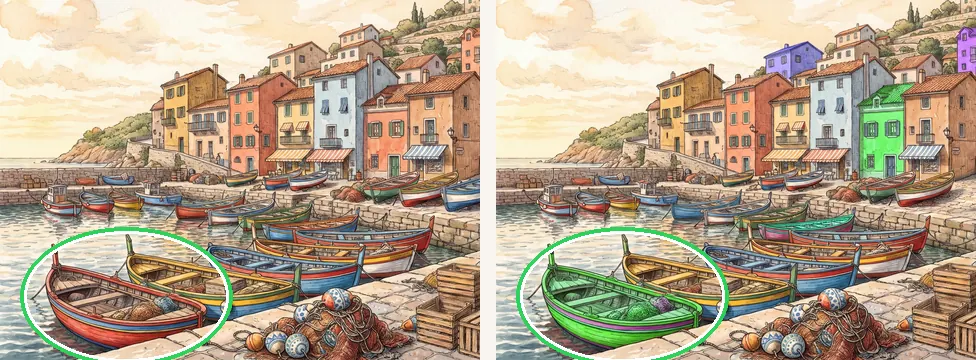
The object stays exactly where it was, with the same shape and size, but in another colour: a boat that turns green, a door in another shade, a cushion that is no longer blue. It is the most frequent type, almost one in three differences.
How to spot it: do a first pass looking only at colour, ignoring shapes. Changes on big objects jump out quickly; the hard ones are small accents, like a flower in a bunch or a shutter on a far house. Compare colours by area, one zone at a time.
2. Replaced object
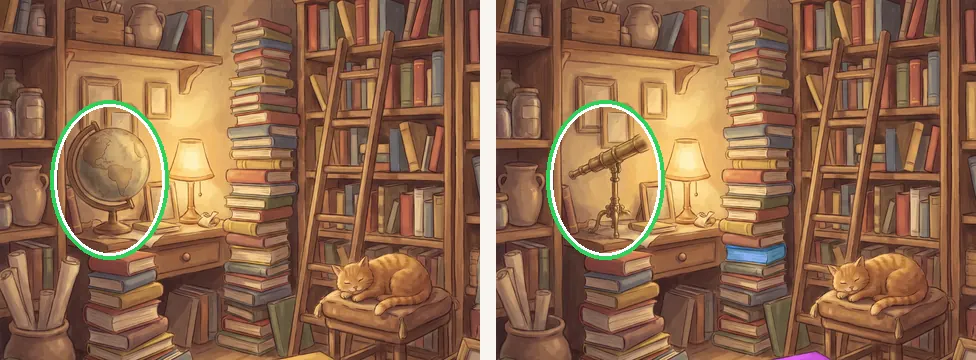
One object is swapped for a different one in the same place: a globe that becomes a telescope, a cushion that becomes another cushion, a window that changes shape. Because the new object fits the scene, the brain accepts it without complaint.
How to spot it: name things in your head as you go, «globe, lamp, books», and check that the second picture has the same list. Look at outlines: the silhouette of the new object rarely matches the old one.
3. Missing object
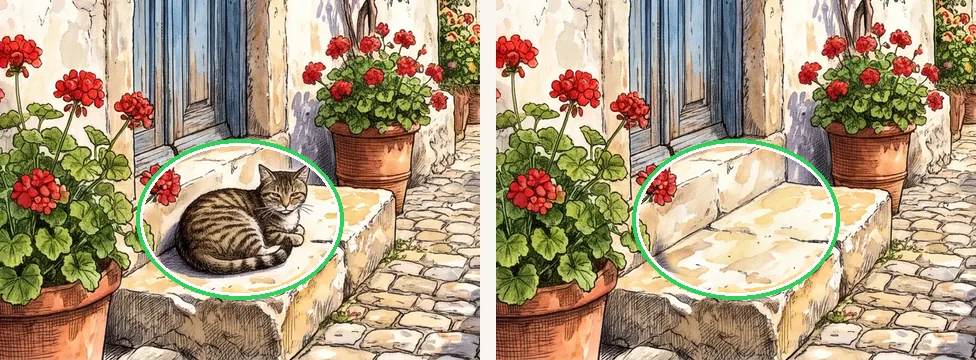
Something is in one picture and not in the other, and in its place you see what was behind it: a wall, a step, the sea floor. Whether you think of it as missing from one picture or added to the other, it is the same difference.
How to spot it: count. Windows, flowers, fish, books. Small objects that repeat are the classic hiding place, because one fewer doesn't change the overall look of the group.
4. Size change
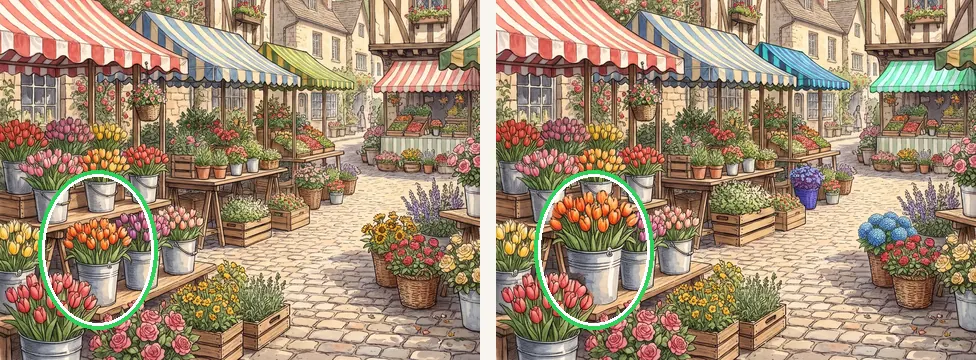
The same object, larger or smaller. Sometimes the change is obvious; often it is subtle, a pot that is a little bigger or a starfish that has shrunk.
How to spot it: compare each object with its neighbours rather than with itself. Does it reach the same height on the shelf? Does it cover the same part of the wall? Does the gap next to it stay the same?
5. Flipped object
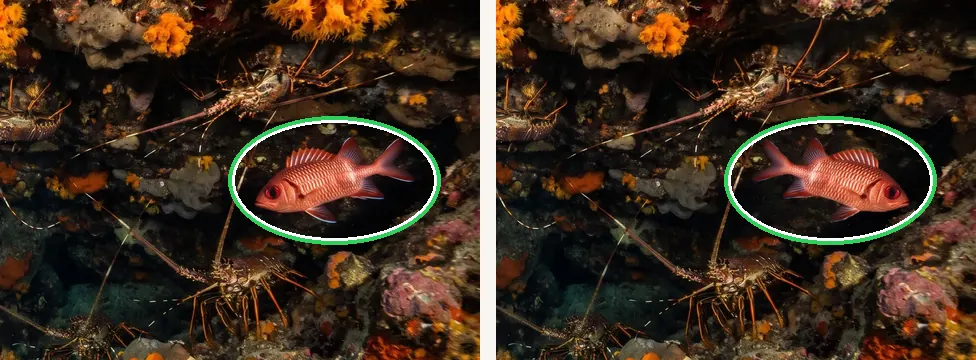
The object is mirrored: a fish that swims the other way, a plant that leans to the opposite side, a handle that moves to the other end. It is the least common type, and one of the hardest, because colour, size and shape all stay the same.
How to spot it: ask where things are pointing. Heads and tails, the direction of a spout or a handle, which way a branch leans. Asymmetric objects are the ones to check.
What you won't find in Difio
Other puzzles also play with objects that move to another place, with numbers or with letters. Difio sticks to these five types, and it guarantees two things:
- Exactly seven, and nothing else. Outside the seven areas, both pictures are identical, pixel for pixel. There are no accidental differences to confuse you.
- All of them are visible. Each one is checked to be large and noticeable enough, and every tap zone has a minimum size, so you don't need pixel-perfect aim on a phone.
How that is achieved is explained in how a Difio level is made. And to put the types into practice, there is the guide on how to find the differences faster.