 Difio
How to find the differences faster
Updated:
Finding differences is less about sharp eyes than about method. These twelve techniques work for any spot-the-difference puzzle, on paper or on a screen, and they are the ones that work best in Difio.
Why differences hide in plain sight
In a classic 1997 experiment, the psychologists Ronald Rensink, Kevin O'Regan and James Clark showed people a photo and a modified version of it, one after the other with a brief blank in between. Even large changes often took a long time to notice. When people were given a short verbal clue about what to look at, they found the change much faster. The researchers' conclusion: to notice that something has changed, we have to be paying attention to that exact spot.
That is the whole secret of these puzzles. The differences are not invisible; your attention simply hasn't landed on them yet. Every technique below is a way of steering your attention around the picture on purpose instead of leaving it to chance.
1. Look at the whole scene first
Before you tap anything, spend a few seconds taking in the picture: what is in the foreground, what is at the back, where the light comes from. With the overall layout in your head, things that are out of place stand out more easily, and you won't waste time rediscovering the scene halfway through.
2. Divide the picture into zones
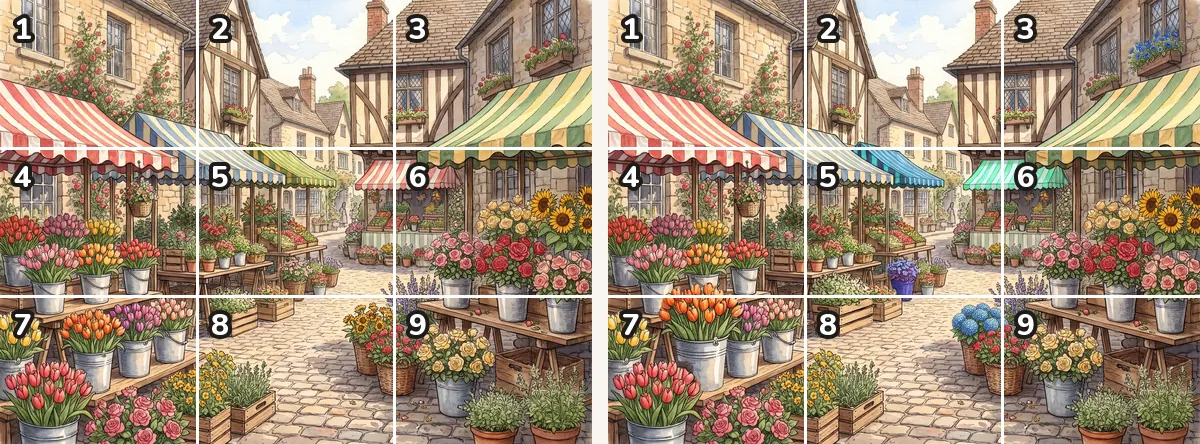
Imagine a grid of three by three over each picture and go through it square by square, always comparing the same square in both pictures. When a square is done, it is done: move on and don't come back unless you have checked everything else. This simple routine stops you from looking at the same corner five times while ignoring another one completely.
3. Jump back and forth over short distances
Pick one object, look at it in the first picture and immediately at the same object in the second. Short, quick jumps between the two versions of a single object work much better than staring at one picture for a long time and then the other. Compare one thing at a time: a door, a pot, a boat.
4. Start with colour
Colour changes are the most common kind of difference in Difio: in the 54 levels published by November 2026, 116 of the 378 differences, almost a third, are a change of colour. A green boat that used to be red, a door that changed shade, a cushion in another tone. Sweep the picture looking only at colours before you go into detail.
5. Count things that repeat
Windows on a façade, books on a shelf, flowers in a pot, fish in a shoal: when things repeat, a missing one is hard to see but easy to count. Count in the first picture, count in the second. More than a fifth of Difio's differences are objects that disappear from one of the pictures.
6. Follow outlines and edges
Run your eyes along the edges of things: the line of roofs against the sky, the top of a shelf, the outline of a rock against the water. A change of shape breaks a silhouette you already know, and silhouettes are easier to compare than textures.
7. Check which way things face
Some differences are a mirror image: a fish swimming the other way, a handle on the other side, a plant leaning to the opposite side. They are the rarest kind in Difio, less than one in ten, and also some of the hardest to notice, because the object is exactly the same, just flipped. Ask yourself where each thing is pointing.
8. Compare sizes
A pot that has grown, a starfish that has shrunk, a bucket of tulips that now takes up more of the shelf. Size changes are easier to spot if you compare an object with whatever is next to it: does it still reach the same height, does it still leave the same gap?
9. Zoom in on busy areas
Shelves full of objects, market stalls and coral reefs are where differences hide best. In Difio you can pinch with two fingers, or use the mouse wheel on a computer, and both pictures zoom in together, so you can drag around and compare details at the same position without losing your place.
10. Don't forget the edges and the background
Our attention goes to the centre and to what is close. That makes the corners, the top strip of the picture and the far background good hiding places. When you are stuck, go round the border of the picture and then look at what is furthest away.
11. Take a short break
If you have been looking at the same picture for a while without finding anything, look away for a moment and come back. When you return you see the scene more as a whole again, and you stop going over the same places. In the iPhone and Android apps, the timer stops while Difio is in the background.
12. Tap with intention and keep hints for the end
Tapping at random rarely pays off. In Difio, each wrong tap counts as a mistake, and three mistakes in two seconds lock the pictures for a moment. Stars depend on how you play: you get one star for finishing, two if you don't use hints, and three if you also make no more than one mistake.
When you really are stuck, use a hint. It tells you what to look at, «Look at the awnings over the stalls in the back», and marks the area on both pictures, exactly like the verbal clue in the experiment above. Your game goes on, but that level can earn only one star.
A routine that works
- A few seconds to take in the whole scene.
- A quick sweep looking only at colours.
- Count anything that repeats.
- Square by square on a 3 × 3 grid, comparing outlines, sizes and direction.
- Zoom in on the busiest areas, the edges and the background.
- A short break, and a hint only if you still need it.
Sources
- Rensink, R. A., O'Regan, J. K. and Clark, J. J. (1997). «To see or not to see: The need for attention to perceive changes in scenes». Psychological Science, 8(5), 368–373. Abstract on the author's page.
- The figures for Difio come from the 54 levels published as of 20 November 2026: 378 differences in all.